
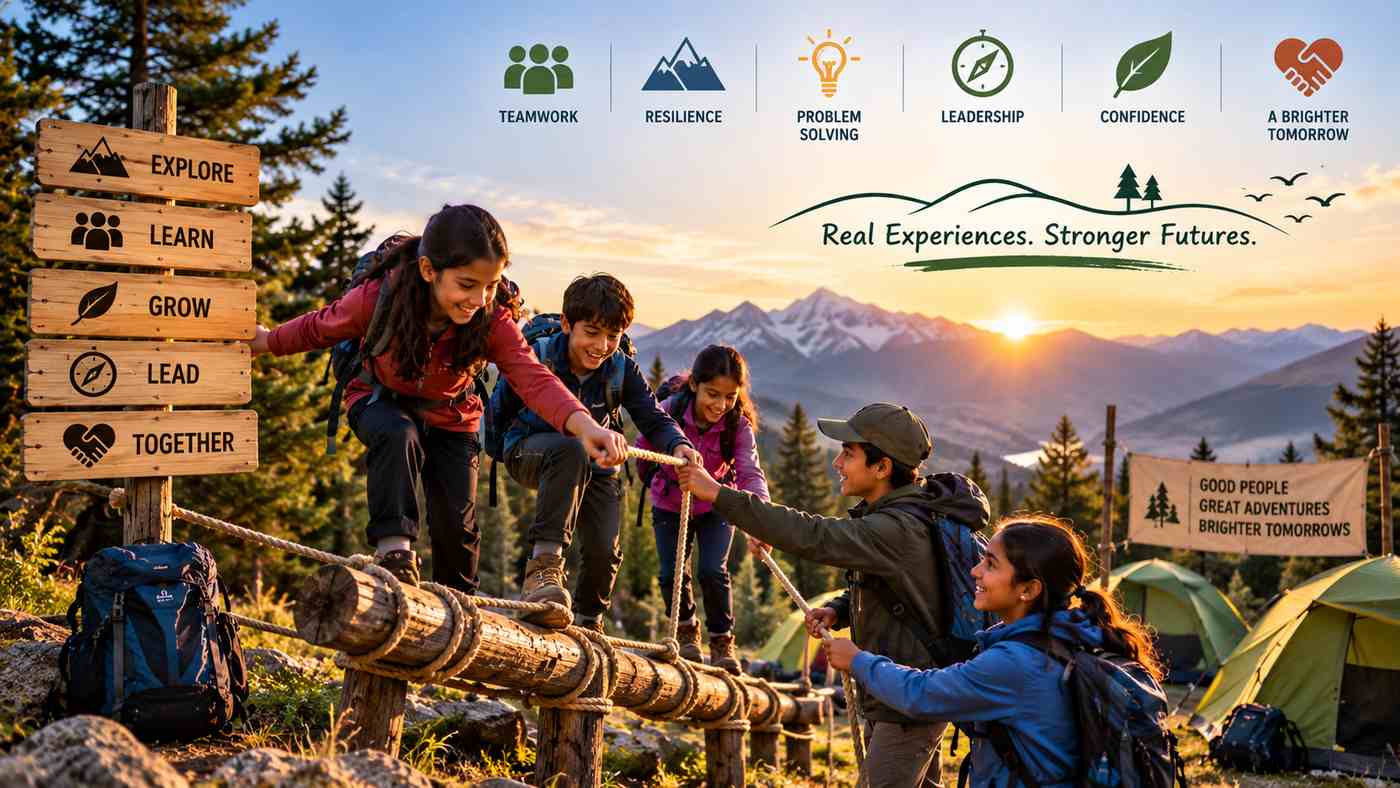

Learning does not always happen at a desk. Sometimes it happens on a trail, during a team challenge, beside a river or around a campfire. Outdoor adventure learning creates situations where students must communicate, make decisions, solve problems and adapt to changing circumstances. The adventure is the experience—but the real outcome is the competency developed through it.bWhen thoughtfully designed, an outdoor programme can transform adventure into purposeful learning and experience into capability.


8
What Makes Outdoor Adventure Learning Different?
Traditional classroom learning often begins with information and moves towards application. Outdoor experiential learning can work in the opposite direction.bStudents first experience a situation, encounter a challenge and then think about what happened.
A trekking route may require planning.
A team obstacle may require communication.
A navigation exercise may require decision-making.
A camping task may require responsibility.
A group challenge may require leadership and cooperation.
This makes the outdoors a practical learning environment where students can apply knowledge instead of simply discussing it.bAdventure education has long incorporated activities such as hiking, climbing, camping, problem-solving exercises, teamwork and structured reflection to support personal and group development.
From Adventure Activities to Real-World Competencies
The value of an adventure programme is not simply the number of activities completed. It is what students learn to do differently because of the experience.
Teamwork Becomes Collaborative Action
A group cannot always complete an outdoor challenge through individual effort.bStudents have to listen, divide responsibilities, encourage one another and coordinate their actions. This creates opportunities to practise collaboration, cooperation and interpersonal communication in a real situation.bThe lesson becomes practical: teamwork is not just a concept—it is something students experience.
Challenges Develop Problem-Solving Skills
Outdoor situations rarely provide students with a ready-made answer.bA team may need to decide how to cross an obstacle, organise equipment or determine the best way forward. Such experiences encourage students to analyse a situation, consider alternatives and make decisions.bThese are transferable critical-thinking and problem-solving skills that can also support academic and everyday situations.


7
Leadership Moves Beyond a Classroom Role
Leadership in an outdoor environment does not necessarily belong to the loudest or most confident student.bA well-designed activity can give different students opportunities to take responsibility—whether by organising a group, communicating instructions, navigating, supporting a teammate or making a decision. This can help students practise initiative, accountability, decision-making and responsible leadership.
Resilience Grows Through Managed Challenges
Not every outdoor activity goes exactly as planned. A difficult trail, unsuccessful attempt or unexpected change can provide a controlled opportunity to experience setbacks. With appropriate supervision and reflection, students can learn to reassess, adapt and try again. The important lesson is not that students should avoid difficulty. It is that difficulty can become an opportunity to learn.
The Missing Link: Reflection
Adventure alone does not automatically create learning. The transformation becomes stronger when students are encouraged to ask:
What happened? Why did it happen? What did I do? What did the team do? What could we do differently next time? Where can I use this learning elsewhere?
Reflection turns an activity into a learning experience. For example, completing a team challenge may demonstrate coordination. A guided discussion afterwards can help students recognise how communication affected the outcome and where similar communication skills could be useful in school or community situations. Experiential learning programmes commonly combine challenge, purposeful activities, facilitation and reflection to help participants connect experience with future behaviour.


7
Turning Outdoor Experiences into Competency-Based Learning
For schools, the next step is to move from activity-based programmes to outcome-based programmes. Instead of asking:
“Which adventure activities should students do?”
ask:
“Which competencies should students develop, and which experiences can help them practise those competencies?”
A simple framework can help:
| Outdoor experience | Possible competency |
|---|---|
| Trekking and navigation | Planning, decision-making |
| Team challenges | Collaboration, communication |
| Rope activities | Confidence, trust, problem-solving |
| Camping responsibilities | Independence, responsibility |
| Nature exploration | Observation, environmental awareness |
| Leadership tasks | Initiative, accountability |
| Reflection sessions | Self-awareness, learning transfer |
This approach makes an adventure learning programme more purposeful and measurable.
Schools can therefore align outdoor experiences with broader developmental objectives rather than treating them simply as recreational activities. Some school outdoor programmes explicitly map adventure activities to outcomes such as teamwork, resilience, growth mindset and environmental responsibility.
Designing Adventure with Purpose
A meaningful outdoor education programme should consider more than destination and activities. Schools should establish:
- Learning outcomes before selecting activities
- Age-appropriate challenges for participants
- Progressive difficulty rather than unnecessary risk
- Clear roles and responsibilities
- Professional supervision and safety procedures
- Reflection and debriefing
- Opportunities to transfer learning back into school life
This changes the programme from “a day outside” into a structured experiential learning journey. Safety must remain fundamental. Professional outdoor programmes commonly emphasise trained instructors, appropriate equipment, supervision, risk management and emergency planning alongside learning objectives.


6
From Experience to Capability
The most meaningful outcome of an adventure programme may not be the photograph taken at the summit or the excitement of completing an obstacle. It may be the student who begins speaking up in a team. The student who learns to listen before deciding. The student who keeps trying after an unsuccessful attempt. The student who takes responsibility without being asked. Or the group that discovers that progress depends on everyone contributing.
That is where outdoor adventure learning becomes competency development.
The outdoors provides the challenge.
The facilitator creates the learning environment.
The student engages with the experience.
Reflection connects the experience to future action.
Together, these elements can turn adventure into learning, learning into competency, and competency into everyday capability. Wanderin’ Man Adventures brings practical experience in designing and delivering structured outdoor programmes for school students, combining adventure with experiential learning and purposeful skill development. Its school programmes include camping, trekking, outdoor challenges, team-building and nature-based experiences, with activities planned around age-appropriate participation, supervision and learning objectives. The organisation also highlights experienced programme leaders, certified mountaineering professionals, safety planning and structured outdoor environments as part of its approach to student development.
Bring Learning Beyond the Classroom
At Wanderin’ Man Adventures, outdoor experiences can be designed around meaningful developmental outcomes rather than adventure alone. From trekking and camping to team-building and experiential learning activities, programmes can be structured to help students practise collaboration, leadership, communication, resilience, responsibility and problem-solving in real-world environments.
Because the goal of adventure is not simply to go farther—it is to return with something that stays with you.
Ready to move beyond activity-based outings and create experiences that develop teamwork, leadership, communication, resilience and problem-solving? Wanderin’ Man Adventures designs structured outdoor and experiential learning programmes for schools, combining adventure, purposeful challenges, professional facilitation and reflection to help students turn real-world experiences into lasting competencies.
Explore our school adventure programmes and discover how the outdoors can become a powerful learning space for your students.
