Measuring Learning Outcomes of Adventure Programs
Adventure programs are often remembered for the excitement of climbing a wall, crossing a river, trekking through the mountains or navigating an unfamiliar trail. But the real educational value goes much deeper. Measuring the learning outcomes of adventure programs helps schools and educators understand whether these experiences are actually developing confidence, leadership, teamwork, resilience and problem-solving abilities. Adventure education is not simply about taking students outdoors. It is about deliberately converting outdoor experiences into meaningful learning.
Why Measuring Adventure Learning Outcomes Matters
A successful adventure program should answer an important question: What did students learn from the experience? Traditional classroom assessment usually focuses on knowledge and academic performance. Adventure learning, however, can develop competencies that are harder to measure, including:
- Leadership and decision-making
- Communication and teamwork
- Confidence and self-awareness
- Resilience and adaptability
- Problem-solving
- Risk awareness
- Responsibility and independence
- Environmental awareness
Measuring these outcomes allows schools to move beyond statements such as “students enjoyed the camp” and identify tangible evidence of student development through experiential learning.
What Should Adventure Programs Measure?
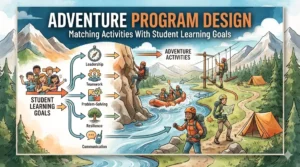
The first practical step is defining the intended learning outcomes before the program begins. For example, if the objective is leadership development, students might be expected to demonstrate initiative, communicate decisions clearly and take responsibility for a group task. For teamwork, measurable outcomes could include active listening, cooperation, conflict management and supporting other participants. A useful framework can therefore include five broad areas:
Personal growth: confidence, independence and self-awareness.
Social skills: communication, cooperation and empathy.
Leadership: initiative, responsibility and decision-making.
Resilience: persistence, adaptability and response to setbacks.
Environmental learning: appreciation, awareness and responsible behaviour toward nature.
Clear outcomes make experiential learning assessment more meaningful and easier to communicate to parents and school leadership.
Setting Practical Standards for Adventure Education
There is no single universal test that can measure every adventure-learning experience. Instead, schools should establish standards based on the purpose, age group and type of program.
A practical standard should be:
- Specific – clearly defines what students should demonstrate.
- Observable – behaviour can actually be seen or recorded.
- Age appropriate – expectations match student maturity.
- Relevant – outcomes connect with curriculum and life skills.
- Measurable – progress can be compared before and after the program.
For example, rather than saying “students will develop confidence,” a stronger learning outcome would be:
“Students will demonstrate increased confidence by voluntarily attempting unfamiliar activities and reflecting on how they managed uncertainty.”
This transforms a broad educational objective into an observable outcome.
Practical Ways to Measure Learning Outcomes
Adventure learning does not require complicated examinations. In fact, simple assessment techniques can often provide better evidence.
Pre- and Post-Program Surveys
Ask students to rate themselves before and after the program on confidence, teamwork, leadership, communication and problem-solving. Comparing responses can highlight changes in student perceptions.
Observation by Instructors
Trained adventure leaders can observe behaviours during activities.
For example, does a student:
- Encourage teammates?
- Take initiative?
- Communicate during a challenge?
- Remain calm after failure?
- Help solve a group problem?
Observation provides behavioural evidence rather than relying only on what students say.
Reflection and Learning Journals
Reflection is one of the most powerful components of experiential learning. After an activity, students can be asked:
What happened? What was difficult? How did you respond? What did you learn? How could you use this learning in everyday life?
These questions help students connect an adventure experience with school, relationships and future challenges.
Teacher Feedback
Teachers can provide valuable evidence because they may observe changes in students after returning to school. Did a previously hesitant student become more willing to participate? Did group communication improve? Did students demonstrate greater responsibility? Teacher observations can help identify whether learning transferred beyond the adventure program.
Measuring Behavioural Change, Not Just Enjoyment
One of the biggest mistakes in evaluating adventure programs is confusing enjoyment with learning. Students may have an excellent time without necessarily achieving the intended learning objectives.
Therefore, assessment should distinguish between:
Experience: “I enjoyed the trekking activity.”
Learning: “I learned to manage fatigue and continue working toward a goal.”
Transfer: “I can apply the same persistence when facing a difficult academic task.”
The third level is particularly important because the ultimate purpose of adventure education is not simply what happens outdoors. It is what students carry back into everyday life.
Using a Simple Adventure Learning Scorecard
Schools can create a straightforward scorecard using a 1–5 scale.
| Learning Area | Before Program | After Program | Evidence |
|---|---|---|---|
| Confidence | 3 | 4 | Attempted unfamiliar activity |
| Teamwork | 3 | 5 | Supported team members |
| Leadership | 2 | 4 | Took responsibility |
| Problem-solving | 3 | 4 | Contributed solutions |
| Resilience | 3 | 5 | Continued after setback |
The numbers alone should not be treated as scientific proof. They become more useful when combined with observations, reflections and teacher feedback.
Making Assessment Meaningful for Students
Assessment should never make adventure programs feel like another classroom examination. The process should be engaging, reflective and age appropriate.
Schools can use:
- Reflection circles
- Group discussions
- Student journals
- Video reflections
- Peer feedback
- Instructor observations
- Personal goal-setting
- Before-and-after questionnaires
The emphasis should be on growth rather than grades. A student who moves from avoiding challenges to attempting them confidently may have achieved an important learning outcome even if their performance is not perfect.
From Adventure Experience to Long-Term Learning
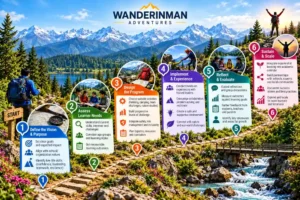
The strongest adventure programs deliberately include three stages:
Prepare → Experience → Reflect
Preparation establishes expectations and personal goals. The adventure creates authentic challenges. Reflection helps students understand what happened and why it matters. Schools can then introduce follow-up activities several weeks later to determine whether students are applying their learning in classrooms, sports, projects and relationships. This is where adventure programs can move from being memorable events to becoming genuine experiential learning interventions.
The Role of Adventure Program Providers
Adventure providers also have an important responsibility in measuring outcomes. A professionally designed program should begin with clearly defined learning objectives rather than simply selecting a collection of exciting activities. Providers should also maintain appropriate safety standards, trained leadership, structured debriefing and documentation of learning outcomes. For schools, this makes it easier to evaluate the educational value of an adventure program and communicate meaningful results to parents and administrators.
Conclusion: Measure What Students Take Home
Measuring the learning outcomes of adventure programs does not mean turning every trek, camp or outdoor challenge into a test. It means asking better questions. Did students become more confident? Did they communicate better? Did they learn to handle uncertainty? Did they demonstrate leadership? Most importantly, can they transfer those lessons into everyday life? When adventure experiences are intentionally designed, observed and followed by reflection, the outdoors becomes more than a playground. It becomes a powerful learning environment. The best adventure program is therefore not simply the one students remember.
It is the one whose lessons they continue to use long after they return home.