Adventure Education vs Traditional Learning: Building Life Skills?
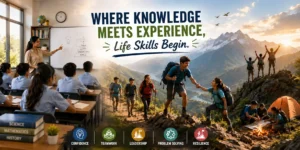
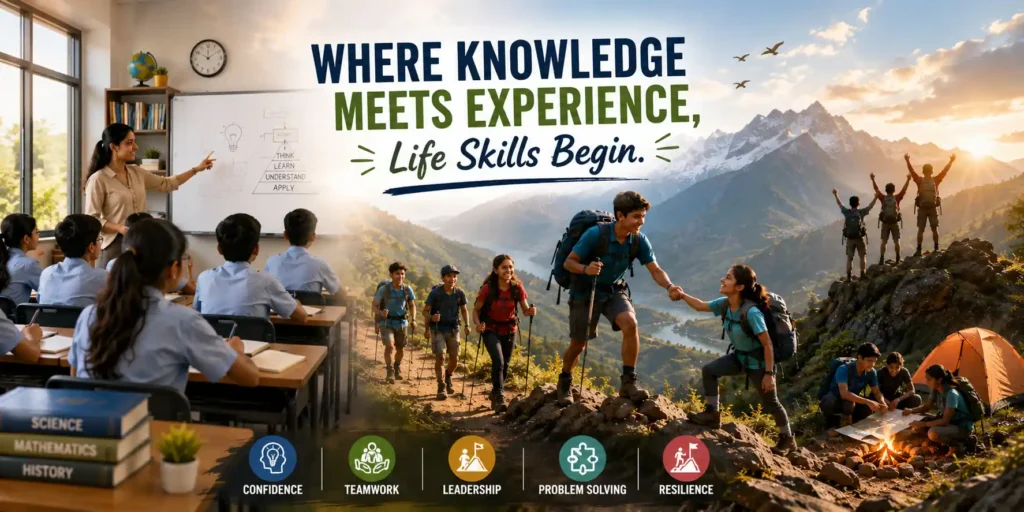
Education is no longer limited to textbooks, examinations, and classroom instruction. Students also need opportunities to develop communication, collaboration, creativity, problem-solving, adaptability, and responsible decision-making. This is where the discussion around Adventure Education vs Traditional Learning becomes important. Traditional learning provides structured academic knowledge and subject foundations. Adventure education uses real-world experiences, outdoor activities, challenges, reflection, and teamwork to help students apply knowledge in practical situations. The question is not necessarily which approach should replace the other. A more useful question for schools is: How can classroom learning and experiential adventure education complement each other?
India’s National Education Policy 2020 places significant emphasis on experiential, hands-on, arts-integrated and sports-integrated learning. The Ministry of Education describes experiential learning as a way of connecting learning with real-life experiences and developing deeper, more meaningful learning.
What Is Traditional Learning?
Traditional learning generally refers to structured classroom education involving teachers, textbooks, curriculum content, assignments, discussions, projects, and assessments. It remains essential because students need strong foundations in subjects such as mathematics, science, languages, social sciences, and other disciplines.
Key strengths of traditional learning
- Structured academic progression
- Subject knowledge and conceptual foundations
- Literacy and numeracy
- Teacher guidance
- Curriculum-based learning
- Individual assessment
- Preparation for formal examinations
- Opportunities for subject specialization
However, classroom instruction alone may not provide frequent opportunities for students to practise decision-making, teamwork, leadership, and problem-solving in changing real-world situations. That is where experiential approaches can add value.
What Is Adventure Education?
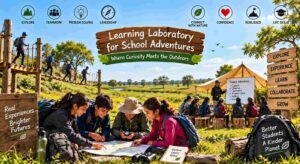
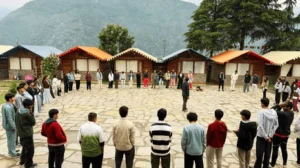
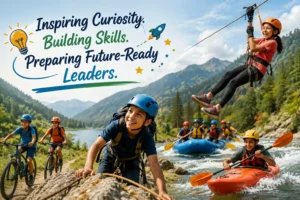
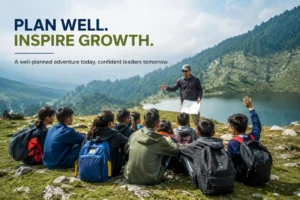
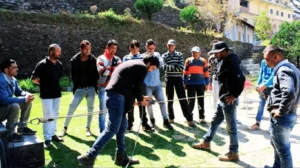
Adventure education is a form of experiential learning in which students learn through carefully designed experiences rather than only through classroom instruction. Activities can include:
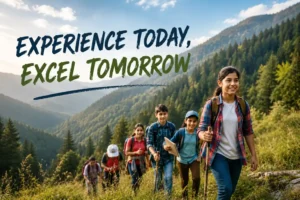
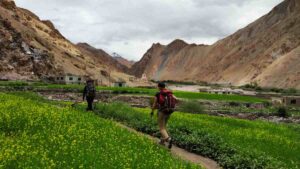
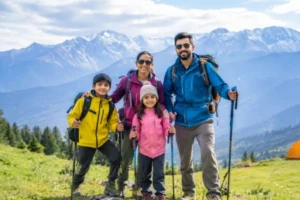
- Trekking and guided nature walks
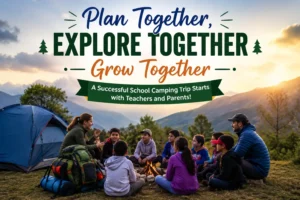
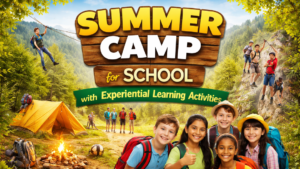
- Camping
- Team-building challenges
- Navigation and orienteering
- Leadership activities
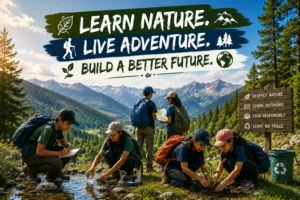
- Environmental projects
- STEM challenges
- Outdoor problem-solving
- Rope-based activities
- Experiential simulations
- Reflection and group discussions
The important distinction is that adventure education should not be treated simply as recreation.
A well-designed program begins with learning objectives and then selects activities that allow students to practise specific competencies. For example, a navigation activity can develop observation, communication, planning, decision-making, and teamwork when students are given defined roles and subsequently reflect on their decisions. Government-led experiential-learning initiatives in India similarly use hands-on activities, field experiences, technology, storytelling, and reflection to connect learning with real-world contexts.
Adventure Education vs Traditional Learning: A Practical Comparison
| Traditional Learning | Adventure Education |
|---|---|
| Primarily classroom-based | Experience-based |
| Strong focus on academic concepts | Strong focus on practical application |
| Teacher-guided instruction | Facilitated exploration |
| Individual assessments are common | Collaboration is often central |
| Structured environment | Dynamic environment |
| Builds subject knowledge | Applies knowledge through experience |
| Curriculum and examination focused | Competency and experience focused |
| Predictable learning setting | Changing real-world situations |
| Reflection through academic work | Reflection through experience and discussion |
These approaches should not be viewed as opposites.
Traditional learning can provide the knowledge; adventure education can provide opportunities to apply, test, and reflect on that knowledge.
Which Approach Builds Life Skills?
Adventure education can create situations where students must use skills that are difficult to practise through explanation alone.
1. Confidence Through Challenge
Confidence develops when students successfully manage appropriately challenging tasks. A student who participates in a navigation exercise, completes a team challenge, presents a solution, or takes responsibility for a group task gains an opportunity to experience achievement directly. The objective should not be to make activities unnecessarily difficult. Challenges should be age-appropriate, progressive, supervised, and inclusive.
2. Leadership Through Responsibility
Leadership is easier to understand when students have an opportunity to practise it. During a structured adventure activity, students may rotate responsibilities such as:
- Team leader
- Navigator
- Timekeeper
- Equipment coordinator
- Safety observer
- Presenter
This allows students to experience planning, delegation, communication, accountability, and decision-making rather than merely reading about leadership.
3. Teamwork Through Shared Goals
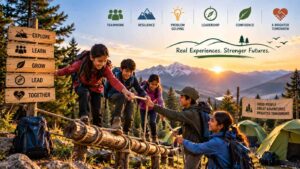
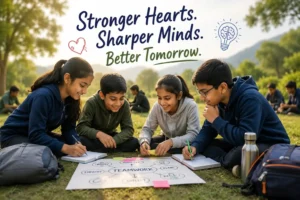
Outdoor challenges often require students to work toward a common objective. For example, a team might have to navigate a route, construct a simple structure, solve an environmental challenge, or complete a problem-solving task within a defined period. Success depends on communication and cooperation rather than the performance of one individual.
4. Problem-Solving Through Real Situations
Adventure environments can introduce changing conditions and incomplete information. Students may need to:
- Analyse a situation
- Identify alternatives
- Discuss consequences
- Make a decision
- Test the decision
- Adapt when circumstances change
This creates a practical setting for critical thinking.
5. Resilience Through Reflection
Not every activity will go exactly as planned. A team may make an incorrect decision, fail to complete a challenge, or need to change its strategy. The educational value comes from what happens next. A structured reflection can ask:
What happened? Why did it happen? What could we have done differently? What will we do next time?
This turns mistakes into learning opportunities. Research on outdoor school-based nature education also indicates that well-designed experiences involving autonomy, collaboration, decision-making, problem-solving, and shared responsibility can support areas such as agency, competence, belonging, and positive youth development, although outcomes vary by program design and research method.
What Are the Benefits of Combining Both Approaches?
The strongest model is often not adventure education versus traditional learning, but traditional learning plus meaningful experiential learning.
Consider a simple example.
A classroom may teach students about water conservation. An experiential program could then ask students to:
- Observe a local water source.
- Identify possible environmental issues.
- Collect observations.
- Work in teams.
- Develop a simple solution.
- Present their findings.
- Reflect on what they learned.
The academic concept remains important. The outdoor experience gives students another context in which to apply it. Similarly, STEM education can combine scientific concepts with engineering challenges, environmental investigations, data collection, and practical problem-solving. Wanderin’ Man’s STEM resources can be connected here through an internal link to its STEM Education in School Programs guide.
How Schools Can Turn Adventure Into Learning
Adventure becomes educational when the program is intentionally designed. A strong school program should follow a simple cycle:
1. Define the Learning Objective
Decide what students should learn or practise. Examples:
- Leadership
- Communication
- Teamwork
- Environmental awareness
- Problem-solving
- Decision-making
- Confidence
2. Choose an Appropriate Activity
The activity should match students’ age, ability, experience, and learning objectives.
3. Give Students Responsibility
Where appropriate, allow students to make decisions, solve problems, communicate, and collaborate.
4. Facilitate Rather Than Simply Direct
Instructors should provide guidance while allowing students to think and participate.
5. Reflect After the Activity
Reflection is essential. Students should discuss what happened, what they learned, what went well, what failed, and how they could apply the learning elsewhere.
6. Connect the Experience Back to School
Teachers can use the experience for:
- Written assignments
- Presentations
- Science projects
- Environmental studies
- Group discussions
- Data analysis
- Creative work
This makes the connection between experience and curriculum explicit. For additional ideas, schools can explore Wanderin’ Man’s guides on experiential simulation, measuring learning outcomes, and environmental education through adventure activities.
Practical Experience in Adventure-Based Learning
Adventure education is most meaningful when learning objectives, outdoor experiences, student participation, and safety are designed together. This article draws on Wanderin’ Man Adventures’ practical experience in designing and delivering adventure-based and experiential programs for students and groups. Wanderin’ Man Adventures works with outdoor learning formats that can include trekking, camping, team-building activities, leadership challenges, environmental learning, experiential simulations, and other structured outdoor experiences. The emphasis is not simply on taking students outdoors. Activities are designed to create opportunities for students to communicate, collaborate, solve problems, make decisions, take responsibility, and reflect on what they have experienced.
Experience in Designing Student Adventure Programs
Effective school adventure programs require more than selecting an attractive destination or activity. Program design should consider:
- Student age and developmental stage
- Fitness and previous outdoor experience
- Learning objectives
- Group size and supervision
- Activity difficulty
- Weather and environmental conditions
- Equipment requirements
- Emergency and first-aid planning
- Instructor qualifications
- Student participation and inclusion
- Reflection and learning outcomes
This practical approach helps schools connect adventure activities with meaningful educational outcomes.
Safety Is Part of Educational Quality
Adventure education should never treat safety as an afterthought. Responsible programs incorporate appropriate activity selection, participant briefings, equipment checks, trained supervision, risk assessment, emergency procedures, weather awareness, and age-appropriate activity design. Schools should independently evaluate the qualifications, safety systems, experience, emergency arrangements, and suitability of any adventure-program provider before making a booking.
Evidence-Informed Perspective
The educational value of adventure-based learning should be considered alongside established principles of experiential and hands-on education. India’s National Education Policy 2020 places emphasis on experiential, hands-on, multidisciplinary and sports-integrated approaches to learning. These approaches encourage students to connect knowledge with practical experiences and develop broader competencies alongside academic understanding. This article therefore presents adventure education as a complement to structured academic learning, rather than as a replacement for classroom education.
Examples of Adventure-Based Learning Activities
STEM Adventure Challenge
Students design a simple bridge or structure using limited materials. They must calculate, build, test, observe failure, modify their design, and explain the final result.
Skills: STEM thinking, creativity, teamwork, testing, problem-solving.
Navigation Challenge
Students work in teams to interpret a map and reach designated points.
Skills: Observation, planning, communication, spatial awareness, decision-making.
Environmental Investigation
Students observe a natural environment and identify evidence of human impact.
Skills: Scientific observation, environmental awareness, research, teamwork.
Leadership Mission
Students receive a group objective with defined constraints and must distribute responsibilities.
Skills: Leadership, delegation, communication, accountability.
Experiential Simulation
Students are presented with a realistic scenario requiring them to make decisions as a team.
Skills: Critical thinking, communication, adaptability, decision-making.
How Schools Should Choose an Adventure Education Provider
Adventure education involves real environments and therefore requires careful planning. Before selecting a provider, schools should ask:
- Are instructors appropriately trained for the activities?
- Is there a documented risk-management process?
- Are activities appropriate for the students’ age and ability?
- Are safety briefings provided?
- Is appropriate equipment available and inspected?
- Are emergency procedures clearly defined?
- Is medical or first-aid support planned?
- Is the instructor-to-student ratio appropriate?
- Are weather and environmental conditions monitored?
- Are learning objectives clearly defined?
- Are reflection and feedback included?
Safety should never be treated as separate from educational quality. Schools can also use a structured school adventure camp planning checklist before selecting a destination, activity, or provider.
Is Adventure Education a Replacement for Traditional Learning?
No. Adventure education should generally be understood as a complement to academic learning rather than a replacement for it. Students still need structured instruction to develop foundational knowledge. At the same time, experiential learning can provide opportunities to apply that knowledge in practical contexts. The Ministry of Education’s description of NEP implementation emphasizes experiential learning, multidisciplinary approaches, critical thinking, problem-solving, and learning connected to real-life contexts. The strongest educational model therefore brings different forms of learning together.
Learn the concept. Experience it. Reflect on it. Apply it again.
Planning an Experiential Adventure Program for Your School?
Adventure education works best when adventure, learning, safety, and reflection are designed together. Wanderin’ Man Adventures can help schools develop experiential programs incorporating adventure activities, teamwork, leadership, outdoor learning, environmental awareness, STEM challenges, and structured student experiences. Programs can be planned around:
- Student age and ability
- Learning objectives
- Program duration
- Location
- Adventure activities
- Safety requirements
- Team-building goals
- Leadership development
- Experiential learning outcomes
If your school is looking to take learning beyond the classroom, contact Wanderin’ Man Adventures to discuss a customized school adventure and experiential-learning program.
Conclusion
The discussion around Adventure Education vs Traditional Learning does not have to be a choice between two competing systems. Traditional learning provides the academic foundation students need. Adventure education can provide opportunities to practise leadership, teamwork, communication, problem-solving, adaptability, and responsible decision-making in meaningful situations. When these approaches are thoughtfully connected, students can move through a powerful learning cycle:
Knowledge → Experience → Reflection → Application
That is the real opportunity behind experiential education: not replacing the classroom, but extending learning beyond it.
The goal is not simply to help students know more. It is to help them understand, apply, collaborate, adapt, and grow.
Planning an Experiential Adventure Program for Your School?
Learning does not have to stop when students leave the classroom. A thoughtfully designed adventure program can give students opportunities to practise leadership, teamwork, communication, problem-solving, decision-making, resilience, environmental awareness, and practical application of knowledge in real-world settings.
Design a Program Around Your School’s Objectives
Wanderin’ Man Adventures can work with schools to develop experiential outdoor programs based on the students’ age, learning objectives, group requirements, duration, destination, and activity preferences. Programs can incorporate:
- Adventure & Outdoor Learning – trekking, camping and age-appropriate outdoor activities
- Leadership Development – structured responsibilities and leadership challenges
- Team Building – collaborative activities built around communication and shared goals
- STEM & Problem-Solving – practical challenges that encourage students to observe, analyse, design and test
- Environmental Learning – nature observation, conservation awareness and responsible outdoor practices
- Experiential Simulations – realistic challenges that encourage decision-making and reflection
- Life-Skills Development – communication, responsibility, adaptability and confidence
Built Around Learning, Not Just Adventure
Every school has different educational priorities. A school may want to strengthen leadership and teamwork, create an environmental-learning experience, complement STEM education, or simply give students an opportunity to learn beyond the classroom. The program should therefore begin with the learning objective, followed by the appropriate activities, supervision, safety planning and reflection.
Give Students an Opportunity to Learn Beyond the Classroom
If your school is planning a school adventure camp, experiential learning program, leadership camp, STEM outdoor activity, trekking program, or customized student adventure experience, speak with Wanderin’ Man Adventures about your requirements. Contact our team to discuss your students, learning objectives, preferred duration, destination, activities, and program requirements.
Plan an Experiential Learning Program with Wanderin’ Man Adventures Your students don’t just need more activities. They need meaningful experiences that help them learn, collaborate, solve problems and grow.