Transformed Learning Experience: How Experiential Learning Improves School Education
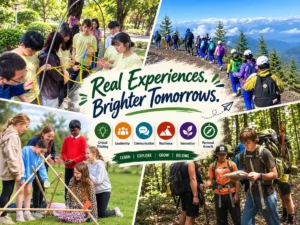
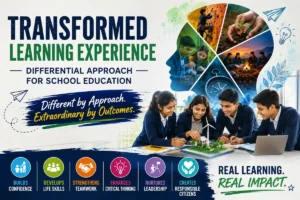
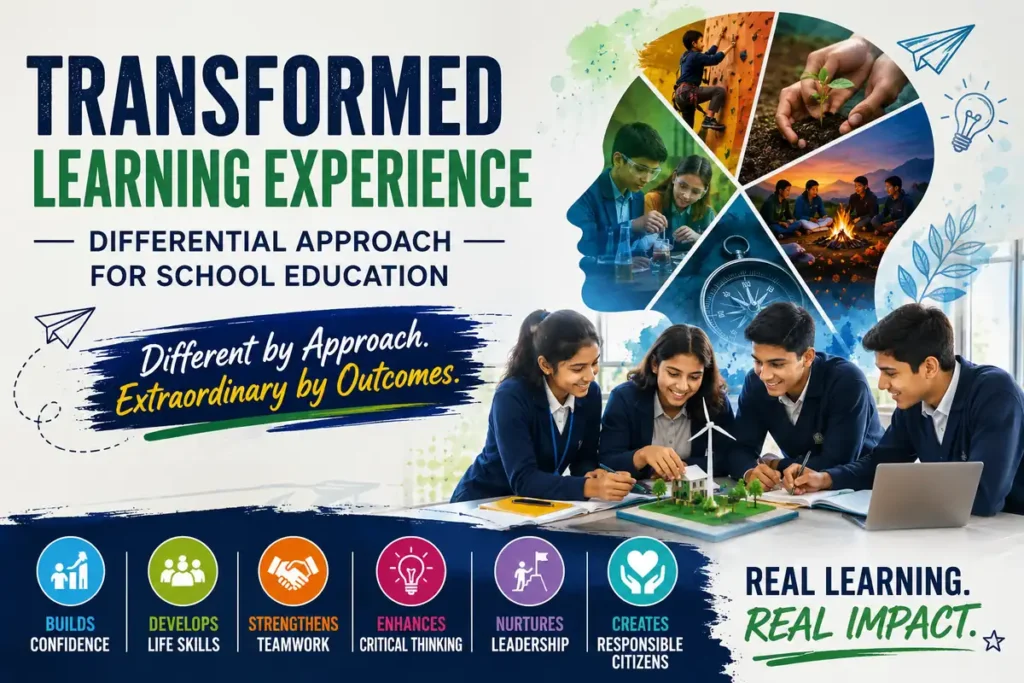
A transformed learning experience moves education beyond simply listening, memorising and reproducing information. It gives students opportunities to participate, explore, solve problems, collaborate, reflect and apply what they learn in meaningful situations. This approach can combine classroom instruction with experiential learning, outdoor education, teamwork, leadership challenges, STEM activities and real-world problem-solving. The objective is not to replace traditional education. It is to extend learning beyond the classroom so students can connect academic knowledge with practical experiences. India’s National Education Policy (NEP) 2020 explicitly encourages experiential learning and describes school education as becoming more holistic, integrated, engaging and relevant to learners. It also encourages experiential learning within subjects and connections between different subjects.
transformed learning experience moves education beyond simply listening, memorizing, and reproducing information. It gives students opportunities to participate, explore, solve problems, collaborate, reflect, and apply what they learn in meaningful situations. This approach can combine classroom instruction with experiential learning, outdoor education, teamwork, leadership challenges, STEM activities and real-world problem-solving. The objective is not to replace traditional education. It is to extend learning beyond the classroom so students can connect academic knowledge with practical experiences. India’s National Education Policy (NEP) 2020 places emphasis on experiential learning, including hands-on, arts-integrated and sports-integrated approaches, while encouraging more interactive, collaborative, exploratory and problem-solving-oriented learning.
What Is a Transformed Learning Experience?
A transformed learning experience is an approach in which students actively participate in the learning process rather than only receiving information. Instead of learning a concept only through explanation or a textbook, students can encounter situations where they need to:
- Observe
- Ask questions
- Analyse information
- Make decisions
- Solve problems
- Work with others
- Test ideas
- Reflect on outcomes
- Apply what they learned
For example, a student can learn about teamwork in a classroom discussion. A carefully designed team challenge can then give the student an opportunity to practise communication, responsibility, cooperation and decision-making. The experience becomes more meaningful when students subsequently reflect on what happened and connect it with their classroom learning.
Why Schools Need a More Experiential Approach
Academic knowledge remains essential, but students also need opportunities to develop competencies that they can use in unfamiliar situations. These can include:
- Critical thinking
- Creativity
- Communication
- Collaboration
- Leadership
- Decision-making
- Problem-solving
- Adaptability
- Responsibility
- Self-management
- Confidence
- Life skills
A transformed approach therefore does not mean abandoning academic learning. It means creating additional opportunities for students to understand, apply and reflect on knowledge. The Government of India’s implementation of experiential-learning pedagogy through CBSE specifically highlights learning connected with real life, reflection, multidisciplinary learning, critical thinking and engagement.
Experiential Learning: Learning Through Real Experiences
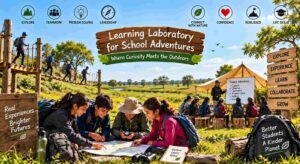
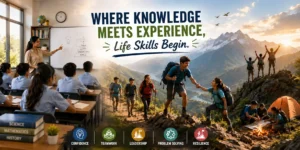
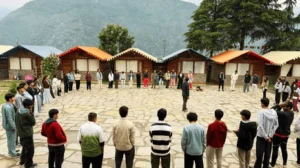
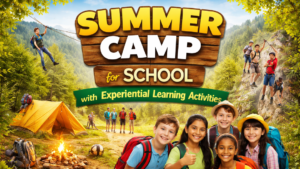
Experiential learning gives students opportunities to learn through purposeful activities and subsequent reflection. Examples for schools can include:
- Outdoor learning
- School camping
- Nature exploration
- Environmental projects
- Navigation activities
- Leadership challenges
- STEM problem-solving
- Team-building exercises
- Experiential simulations
- Community-based projects
For example, students participating in a navigation activity may need to interpret a map, plan a route, divide responsibilities and communicate with their teammates. The educational value comes not simply from completing the activity, but from helping students understand what they did, why they made particular decisions and what they could apply elsewhere. The Ministry of Education’s PRERANA program provides another Indian example of experiential education, using hands-on activities, reflection and value-based learning as part of a structured student experience.
How Adventure-Based Learning Supports Student Development
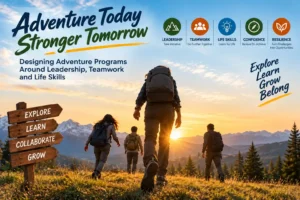
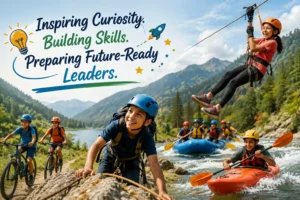
Adventure-based learning can add a practical dimension to school education when activities are appropriately designed, supervised and connected with learning objectives.Activities should be appropriate to students’ age, abilities, previous experience and safety requirements. The purpose is not simply to make students step outside their comfort zones, but to create meaningful situations in which they can practise skills, make decisions, collaborate and reflect.
Confidence
Completing an appropriately challenging activity can give students an opportunity to experience achievement and recognise their own capabilities.
Leadership
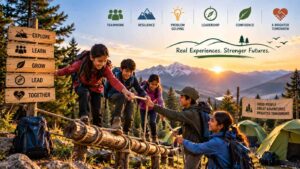
Students can rotate responsibilities such as team leader, navigator, timekeeper or equipment coordinator. This provides opportunities to practise responsibility, communication and decision-making.
Teamwork
Group challenges require students to communicate, listen, cooperate and work toward a shared objective.
Decision-Making
Students can be given structured situations in which they need to evaluate information, consider alternatives and make appropriate choices.
Resilience
A challenge that does not go according to plan can become an opportunity to reflect, adjust an approach and try again. The educational value therefore comes not simply from the adventure itself, but from purposeful activity design, facilitation and reflection.
Developing Life Skills Beyond the Classroom
School education can provide opportunities for students to practise skills that are useful beyond academic examinations. Experiential programs can create situations where students practise:
- Communication
- Leadership
- Time management
- Conflict resolution
- Teamwork
- Problem-solving
- Adaptability
- Responsibility
- Decision-making
- Self-management
For example, a team that fails to complete a challenge within a given time can review how it communicated, whether responsibilities were clear and what it could change during the next attempt.
This turns an activity into a learning cycle rather than simply an event.
The Learning Cycle: Experience → Reflection → Application → Transfer
A strong transformed learning experience can follow four stages.
1. Experience
Students participate in a meaningful activity or challenge.
2. Reflection
Students discuss what happened, what worked, what did not work and why.
3. Application
Students identify the concepts, behaviours or skills involved.
4. Transfer
Students consider where the same learning can be applied in school, everyday life or future situations.
This structure helps schools move from “students did an activity” to “students learned from the activity.”
The Role of Teachers in Transformed Learning
Experiential learning does not make teachers less important. Instead, teachers can become facilitators who help students connect experiences with learning objectives. Before an activity, teachers can establish expectations and learning goals. During the activity, they can observe, guide and ask questions without unnecessarily taking over the problem-solving process. After the activity, reflection can help students understand their experience. Useful questions include:
- What did you learn?
- What challenged your team?
- How did you make your decision?
- What worked well?
- What went wrong?
- How did your team respond?
- What would you change next time?
- Where could you use this learning again?
Connecting Academic Learning With Real-World Experiences
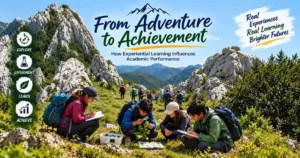
Experiential learning can complement several school subjects.
Science
Students can conduct environmental observations, field investigations or simple scientific challenges.
Mathematics
Navigation, distance, measurement, time and data collection can provide practical mathematical contexts.
Geography
Maps, terrain, landscapes and field observations can connect classroom concepts with the physical environment.
Environmental Studies
Nature camps, biodiversity observations and conservation activities can create opportunities for field-based learning.
STEM
Students can design, build, test and improve simple structures or solutions using limited materials.
Physical Education
Outdoor activities can combine physical movement with teamwork, planning and responsible decision-making. This interdisciplinary approach reflects the broader direction of NEP 2020, which encourages experiential learning and connections across subjects.
Creating Inclusive and Student-Centred Learning
A transformed learning experience should not be designed around one type of student. Activities can be adapted according to:
- Age
- Physical ability
- Previous experience
- Confidence
- Learning requirements
- Group dynamics
- Environmental conditions
Not every student needs to perform the same role. One student may demonstrate leadership, another may excel at observation, another at communication, while another may contribute through planning or creative problem-solving. The objective should be to provide meaningful opportunities for participation, rather than comparing students against one another.
Practical Examples of Transformed Learning
Outdoor Navigation Challenge
Students work in teams to interpret a map, plan a route and reach designated points.
Learning opportunities: communication, geography, planning, teamwork and decision-making.
STEM Construction Challenge
Students receive limited materials and must design and test a simple structure.
Learning opportunities: mathematics, engineering thinking, creativity, testing and problem-solving.
Environmental Investigation
Students observe a natural environment and document evidence of human or environmental changes.
Learning opportunities: scientific observation, data collection, environmental awareness and teamwork.
Leadership Challenge
Students receive a group objective and divide responsibilities among team members.
Learning opportunities: leadership, delegation, communication and accountability.
How Schools Can Measure Learning Outcomes
A transformed learning experience should not be evaluated only through examination marks.
Schools can use multiple indicators, such as:
- Student participation
- Communication
- Collaboration
- Leadership behaviour
- Problem-solving
- Decision-making
- Adaptability
- Reflection quality
- Teacher observations
- Student feedback
- Post-program discussions
A simple pre- and post-program reflection can also help teachers identify changes in students’ perceptions and learning. The objective is not to claim that one outdoor activity automatically transforms a student’s personality. Rather, schools can observe and document the competencies students practise during a structured program.
Safety and Structure Are Essential
Experiential learning does not mean removing structure. For outdoor and adventure-based programs, schools should consider:
- Age-appropriate activities
- Risk assessment
- Qualified and trained supervision
- Appropriate equipment
- Safety briefings
- Weather and environmental conditions
- Emergency procedures
- First-aid arrangements
- Suitable instructor-to-student ratios
- Clear communication with teachers and school authorities
Safety should be integrated into program design from the beginning. The right balance is meaningful challenge within a properly managed environment.
How Schools Can Create a Transformed Learning Experience
Schools can follow a simple framework:
Define the objective → Select the experience → Prepare students → Facilitate the activity → Reflect → Connect to curriculum → Measure learning
For example, if the objective is leadership, the school should not simply select an exciting adventure activity. Instead, it can:
- Define the leadership competencies.
- Design appropriate student roles.
- Brief students on expectations.
- Conduct the activity.
- Observe student behaviour.
- Conduct structured reflection.
- Connect the experience with classroom learning.
- Record observations and feedback.
This makes the program purposeful, measurable and educational.
About the Experience Behind This Article
Wanderin’ Man Adventures approaches outdoor and experiential programs as structured learning experiences rather than simply recreational outings. Its school-oriented activities can incorporate adventure, outdoor learning, teamwork, leadership, environmental awareness, experiential simulation and practical challenges according to the requirements of the participating institution. The article is written from a practical adventure and business perspective and is intended to complement—not replace—formal educational research and professional school guidance.
Planning a Transformed Learning Experience for Your School?
A successful experiential program begins with a learning objective, not simply an activity. Wanderin’ Man Adventures can help schools plan structured outdoor and experiential programs around:
- Student age and ability
- Learning objectives
- Program duration
- Destination
- Adventure activities
- Leadership development
- Team-building objectives
- STEM and problem-solving activities
- Environmental learning
- Safety requirements
Programs can be designed to complement classroom education while giving students opportunities to experience, reflect, apply and transfer their learning. Whether your school is considering an experiential learning program, school adventure camp, leadership program, outdoor education experience, STEM activity or customized student adventure program, the right structure can turn an outdoor activity into a meaningful learning opportunity.
Experiential Learning and India’s Education Framework
Experiential learning is not simply an alternative outdoor activity. It is increasingly recognised within India’s broader educational framework. The National Education Policy 2020 calls for experiential learning to be adopted across stages of education, including hands-on, arts-integrated and sports-integrated approaches. It also encourages more interactive, collaborative, exploratory and problem-solving-oriented learning. The Ministry of Education’s documentation on experiential-learning implementation describes approaches designed to connect learning areas with students’ lives and the world around them. It also highlights the role of reflection, multidisciplinary learning and real-life connections.
The Government of India’s PRERANA programme provides another example of an experiential-learning initiative that combines hands-on activities, technology, reflection and value-based learning. For schools, this reinforces an important principle: experiential learning should not be treated as a replacement for academic education. It can be used as a structured way to help students connect knowledge with experience and application.
Connecting Academic Learning With Real-World Experiences
Experiential activities can provide practical contexts for applying concepts taught in school.
Science
Students can conduct field observations, investigate local environmental conditions or document biodiversity.
Mathematics
Navigation activities can involve distance, time, measurement, direction and basic data collection.
Geography
Students can interpret maps, observe terrain and connect classroom concepts with real landscapes.
Environmental Studies
Nature-based activities can introduce students to biodiversity, conservation and responsible use of natural resources.
STEM
Students can design, build, test and improve a simple structure or solution using limited materials.
Physical Education
Outdoor activities can combine physical movement with teamwork, planning, responsibility and decision-making. The purpose is not to turn every outdoor activity into a formal lesson. Instead, schools can identify where an experience naturally reinforces an existing learning objective.
How Schools Can Measure Experiential Learning Outcomes
The success of a transformed learning experience should not be judged only by whether students enjoyed the activity. Schools can combine several forms of evidence:
| What to assess | Possible evidence |
|---|---|
| Communication | Teacher observation, peer feedback |
| Teamwork | Group performance and reflection |
| Leadership | Student responsibilities and decision-making |
| Problem-solving | Solutions proposed and tested |
| Participation | Activity engagement |
| Reflection | Student journals or post-activity discussion |
| Adaptability | Response when plans change |
| Application | Ability to connect the experience with classroom learning |
A short pre-program and post-program reflection can also help teachers understand how students perceived their confidence, teamwork, decision-making and learning. These measures should be interpreted carefully. A single activity cannot establish that a student’s personality or academic performance has permanently changed. The purpose is to document the skills students practised and the learning they can articulate from the experience.
Conclusion
A transformed learning experience does not require schools to choose between classroom education and experiential learning. Classroom teaching provides essential academic foundations. Experiential learning can create opportunities for students to apply knowledge, collaborate, solve problems, make decisions and reflect on their experiences. The most meaningful approach is therefore not simply:
Learn → Remember
but:
Experience → Reflect → Apply → Transfer
When thoughtfully designed, experiential and outdoor learning can complement academic education and give students additional opportunities to develop practical competencies that can support their learning and everyday lives. The goal is not to replace the classroom.
It is to extend learning beyond it.