STEM Education in School Programs: Future-Ready Students
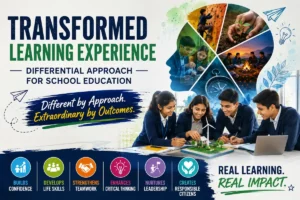
Today’s students are growing up in a world shaped by artificial intelligence, automation, data, robotics and rapid technological change. STEM education in school programs helps students move beyond memorising concepts by connecting science, technology, engineering and mathematics with practical problem-solving, creativity and real-world experiences. A strong STEM program does more than introduce coding or robotics. It encourages students to ask questions, investigate problems, test ideas, learn from mistakes and collaborate on solutions. When STEM is combined with experiential learning, students can connect classroom knowledge with situations they can observe, explore and understand. India’s National Education Policy 2020 places significant emphasis on experiential, hands-on and multidisciplinary learning. Government education initiatives have also promoted experiential learning as a way to make education more engaging, meaningful and connected to real life.
What Is STEM Education?
STEM stands for:
- S — Science
- T — Technology
- E — Engineering
- M — Mathematics
STEM education connects these disciplines through practical challenges rather than treating every subject as an isolated area of knowledge. For example, students could be asked to design a lightweight bridge. They may study forces in science, calculate dimensions using mathematics, use engineering principles to develop the structure and apply technology to model or test their design. The objective is not simply to produce a finished model. Students learn how to observe, analyse, design, test, communicate and improve.
Why STEM Education Matters in School Programs
Schools increasingly need learning experiences that develop both subject knowledge and transferable skills. Well-designed STEM activities can give students opportunities to develop:
- Critical thinking
- Problem-solving
- Creativity
- Collaboration
- Communication
- Digital literacy
- Analytical reasoning
- Decision-making
- Adaptability
- Innovation
The real value comes from giving students meaningful problems to solve rather than simply giving them information to remember.
Benefits of STEM Education for Students
1. Develops Critical Thinking
STEM challenges encourage students to examine evidence, compare alternatives and explain why a particular solution may work. Instead of asking only, “What is the answer?”, students begin asking:
“Why does it work?”
“What could be improved?”
“What happens if we change one variable?”
This encourages inquiry and independent thinking.
2. Encourages Creativity and Innovation
STEM does not always have one perfect solution. Students can design prototypes, experiment with materials, create models and modify their ideas after testing them. This creates a practical connection between imagination and innovation.
3. Strengthens Problem-Solving Skills
A STEM project may not work on the first attempt—and that is part of the learning process. Students can identify the problem, analyse possible causes, test alternatives and improve their design. The process teaches an important lesson:
Failure can provide information for the next solution.
4. Builds Teamwork and Leadership
Many STEM projects are collaborative. Students may need to divide responsibilities, communicate ideas, manage time, resolve disagreements and present a final solution. These experiences create opportunities to practise leadership and teamwork in an authentic setting.
5. Builds Digital and Technological Confidence
Age-appropriate STEM programs can introduce students to areas such as:
- Coding
- Robotics
- Data analysis
- Electronics
- Artificial intelligence concepts
- Digital design
- Internet of Things
- 3D modelling
The emphasis should remain on understanding and application rather than technology for its own sake.
How Experiential Learning Enhances STEM Education
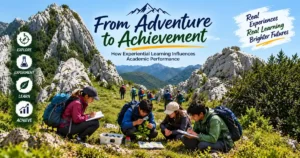
The strongest connection between STEM and experiential education occurs when students learn by doing, reflect on the experience and apply what they have learned.
For example:
Observe → Question → Design → Test → Analyse → Improve → Present
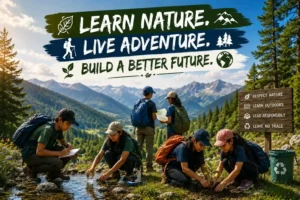
This learning cycle can be applied inside a classroom, laboratory, school campus, nature setting or structured outdoor program. An environmental activity could involve observing water, soil, plants or local biodiversity. Students can collect observations, organise information, identify a problem and propose practical solutions. This makes STEM less abstract and more connected to the world students can see around them. India’s education policy framework explicitly promotes experiential and hands-on learning, including multidisciplinary and sports-integrated approaches.
STEM Activities for Different Age Groups
Primary School Students
Age-appropriate activities may include:
- Simple science experiments
- Nature observation
- Mathematical games
- Building challenges
- Basic coding
- Simple engineering models
The focus should be curiosity, observation and discovery.
Middle School Students
Students can progress towards:
- Robotics
- Electronics
- Model bridge construction
- Environmental investigations
- Coding challenges
- Water and energy projects
- Design-and-build activities
Senior School Students
More advanced activities may include:
- Artificial intelligence concepts
- Data analysis
- IoT models
- Renewable-energy projects
- App development
- 3D design
- Engineering challenges
- Research-based projects
Activities should always be matched to students’ age, prior knowledge, available resources and learning objectives.
How Wanderin’ Man Can Connect STEM With Experiential Learning
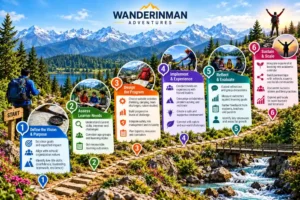
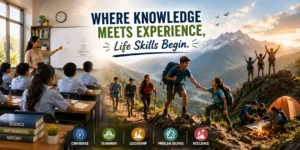
At Wanderin’ Man, the opportunity is to take STEM beyond a conventional classroom activity and connect it with outdoor education, environmental exploration, adventure-based challenges and structured experiential learning. A STEM-oriented experiential program can follow a simple framework:
Learning objective → Real-world challenge → Team activity → Observation and experimentation → Reflection → Application
For example, students could investigate environmental conditions during a nature-based activity, use measurement and observation skills, work collaboratively to identify a challenge and then present possible solutions. Similarly, an engineering challenge can ask teams to design, build, test and improve a structure using limited resources. The important point is that the activity should have a clear learning outcome, not simply provide entertainment. This approach complements Wanderin’ Man’s broader philosophy of taking learning beyond the classroom through structured school adventure and experiential programs.
How Schools Can Implement STEM Programs Successfully
Schools considering STEM education should focus on five areas:
1. Start With Learning Outcomes
Define what students should understand or be able to demonstrate after the activity.
2. Use Hands-On Projects
Allow students to build, test, investigate and modify rather than only listen to explanations.
3. Connect Subjects
A single project can incorporate science, mathematics, technology, communication and design.
4. Include Reflection
After an activity, students should discuss:
- What happened?
- What worked?
- What failed?
- Why did it happen?
- What would we change?
- Where can we apply this learning?
Reflection converts activity into learning.
5. Prioritise Safety
School STEM and experiential programs should use age-appropriate activities, competent facilitators, appropriate equipment, risk assessment and emergency procedures.
What Should Schools Look for in a STEM Program?
Before selecting a STEM or experiential-learning partner, schools should consider:
- Clearly defined learning objectives
- Age-appropriate activities
- Qualified and experienced facilitators
- Hands-on learning
- Small-group collaboration
- Safety and risk-management procedures
- Opportunities for reflection
- Customisation for school requirements
- Measurable learning outcomes
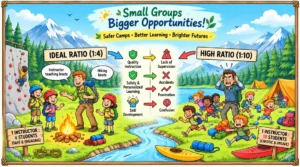
- Appropriate student-to-facilitator arrangements
The cheapest or most technology-heavy program is not necessarily the most educational. Schools should evaluate how effectively the program connects activity, learning and student development.
STEM Education and the Future of Learning
The future of education will require students to combine knowledge from different disciplines. Artificial intelligence, robotics, biotechnology, renewable energy, data science, cybersecurity and advanced engineering are examples of fields where scientific and technological knowledge increasingly intersect. However, future readiness is not only about technical knowledge. Students also need to communicate, collaborate, adapt, evaluate information and solve unfamiliar problems. That is why STEM education is most valuable when it develops both technical understanding and human capabilities.
Looking for a STEM-Based Experiential Program for Your School?
STEM becomes more meaningful when students can observe, explore, experiment, solve and reflect. Wanderin’ Man Adventures can help schools create structured experiential-learning experiences that connect outdoor education, adventure activities, teamwork, problem-solving and real-world learning. Programs can be designed around:
- Student age and grade
- Learning objectives
- Program duration
- Group size
- Location
- Outdoor activities
- STEM and environmental themes
- Teamwork and leadership outcomes
Conclusion
STEM education in school programs can help students connect academic concepts with practical problems and real-world situations. Its greatest value lies not simply in teaching technology, coding or robotics, but in developing curiosity, critical thinking, creativity, collaboration and the confidence to test and improve ideas. When STEM is combined with structured experiential learning, students can move from learning about a concept to applying it. For schools, the opportunity is to create learning environments where students do more than find answers—they learn how to ask better questions, solve problems and turn ideas into action.