Fostering Creativity and Innovation Through Adventure
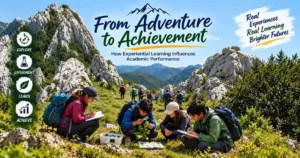
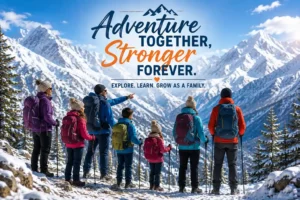
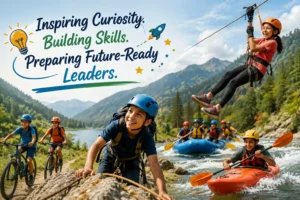
What happens when students step away from desks, textbooks and familiar routines and enter an environment where there is no single right answer?They begin to think differently. A trail, climbing wall, campsite or outdoor challenge can become much more than an adventure. It can become a laboratory for ideas, decisions and experimentation. This is the essence of fostering creativity and innovation through adventure—giving students opportunities to observe, question, experiment, collaborate and discover solutions in situations that feel real.


Why Creativity Needs More Than a Classroom
Creativity is often associated with art, writing or music. But creativity is much broader. It is the ability to generate possibilities, connect ideas, approach problems differently and imagine alternatives. Similarly, innovation is not simply about inventing something completely new. It involves turning ideas into practical solutions. Traditional classroom learning provides essential knowledge. Adventure-based learning adds something different: uncertainty. Students may encounter an obstacle without knowing exactly how to overcome it. They have to assess the situation, discuss possibilities, test an approach and adapt when it does not work. That process naturally encourages creative thinking.
Adventure Turns Students Into Problem Solvers
Imagine a group of students facing a team challenge.
The first solution doesn’t work.
Do they give up?
Or do they reconsider the problem?
Perhaps they change their strategy, redistribute responsibilities or try a completely different approach. That simple cycle—attempt, evaluate, adapt and try again—is at the heart of innovation. Adventure activities can therefore strengthen:
- Creative problem-solving
- Decision-making
- Critical thinking
- Logical reasoning
- Adaptability
- Resourcefulness
- Collaboration
- Confidence
These are skills students can carry from an outdoor challenge into academic, professional and everyday situations.


Learning Through Experimentation
Innovation rarely happens perfectly on the first attempt. Great innovators experiment. Adventure learning creates a similar environment. A student may try a particular route, climbing technique, navigation strategy or team arrangement. The result provides immediate feedback. If it works, they learn why. If it fails, they have another opportunity to rethink their approach. This makes failure less intimidating. Instead of seeing mistakes as something to avoid, students can begin viewing them as information that helps improve the next attempt. That mindset is crucial for developing resilient and innovative learners.
Outdoor Education Encourages Curiosity
Curiosity is the starting point of creativity. When students explore unfamiliar environments, they naturally begin asking questions:
Why is this trail designed this way?
How can we cross this obstacle?
Which route should we take?
What happens if we change our strategy?
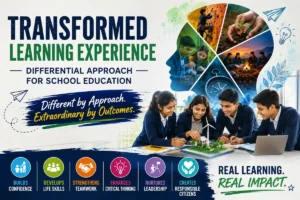
Outdoor education provides countless opportunities for such questions. Nature itself becomes a learning resource. Students can observe ecosystems, understand geography, explore weather patterns, identify plants and animals, and discover how environmental conditions influence decisions. The result is experiential learning that connects knowledge with experience.


Creativity Grows When Students Work Together
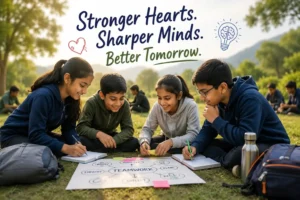
Innovation is rarely a completely individual process. Many important ideas emerge when people exchange perspectives. Adventure challenges naturally encourage teamwork. One student may identify a problem while another proposes a solution. A third may notice a risk that others overlooked. Different perspectives produce better possibilities. Structured adventure programs can therefore help students learn how to:
- Listen to different viewpoints
- Communicate ideas clearly
- Accept constructive feedback
- Share responsibility
- Resolve disagreements
- Build on another person’s idea
These collaborative experiences help transform individual creativity into collective innovation.
Adventure Builds Confidence to Think Differently
Students sometimes hesitate to share unusual ideas because they are afraid of being wrong. Adventure can change that behaviour. When students successfully complete a challenge that initially appeared difficult, they experience something powerful: “I can figure this out.” That confidence can influence how they approach future problems. A student who becomes comfortable making decisions on a trail may become more willing to participate in classroom discussions. A student who learns to recover from an unsuccessful attempt may become less afraid of experimenting with a new idea. Confidence does not automatically create creativity—but it creates an environment where creativity is more likely to emerge.
From Comfort Zone to Innovation Zone
Innovation requires a willingness to move beyond familiar approaches. Adventure experiences do exactly that. Students encounter unfamiliar places, activities, responsibilities and challenges. With appropriate safety systems and professional guidance, they can step outside their comfort zones without being placed in unnecessary danger. This transition can be transformative:
Comfort → Challenge → Experimentation → Discovery → Confidence
The objective is not to make students uncomfortable for its own sake. It is to help them discover that uncertainty can be managed and challenges can be approached creatively.


How Schools Can Use Adventure to Develop Innovation
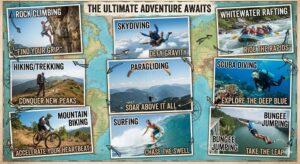
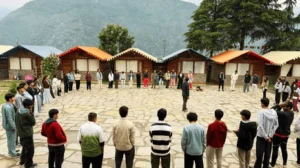
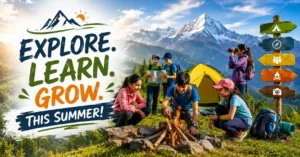
Adventure does not have to mean a multi-day expedition. Schools can integrate creativity and innovation into different experiential learning activities, including:
- Team-building challenges
- Navigation and orienteering
- Nature-based projects
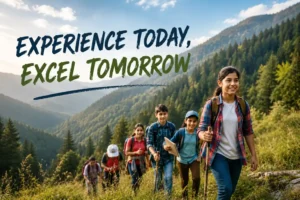
- Trekking activities
- Outdoor problem-solving games
- Leadership exercises
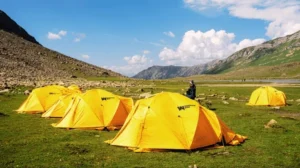
- Camping challenges
- Environmental projects
- Adventure-based STEM activities
- Reflection and group discussions
The important factor is intentional program design. An activity becomes more educational when students understand the challenge, make decisions, experience the outcome and reflect on what they learned.
The Role of Reflection in Creative Learning
Adventure alone does not guarantee learning. Reflection completes the experience. After an activity, teachers and facilitators can ask:
What happened?
What did you try?
Why did your first approach work—or fail?
What would you change next time?
Where could you use this learning outside the activity?
These questions transform an exciting experience into meaningful learning. Students begin connecting outdoor experiences with academic learning, personal development and real-world problem-solving.
Why Adventure-Based Learning Matters for the Future
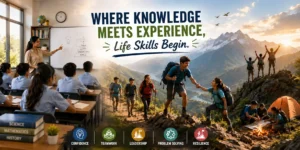
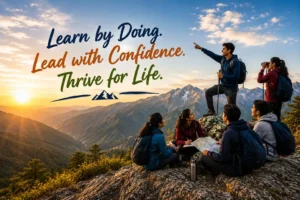
The future will not simply reward students who can remember information. It will increasingly value people who can adapt, collaborate, solve unfamiliar problems and generate useful ideas. That makes creativity and innovation essential educational outcomes. Adventure-based learning provides an engaging way to develop these capabilities while also nurturing resilience, leadership, communication and confidence. The mountain trail, therefore, becomes more than a destination. It becomes a classroom without walls.
Conclusion: Let Students Discover Their Own Solutions
Fostering creativity and innovation does not always require sophisticated technology or complicated teaching methods. Sometimes, it begins with a challenge. Give students a problem they cannot solve immediately. Give them space to discuss, experiment, make decisions and try again. Then allow them to reflect on the experience. That is the adventure way. Because when students stop asking “What is the correct answer?” and start asking “What could we try?”, creativity begins. And when they turn those possibilities into workable solutions, innovation begins.
Give Learning a New Direction
At Wanderin’ Man Adventures, adventure-based programs can be designed to combine outdoor experiences with teamwork, leadership, experiential learning and personal development. The objective is simple: take learning beyond the classroom and turn challenges into opportunities for discovery.